The Tridentine Mass Step by Step
A guide for those discovering the Tridentine Mass, missal in hand: what the priest does, what the prayers say, what posture to adopt, from the first sign of the cross to the Last Gospel.
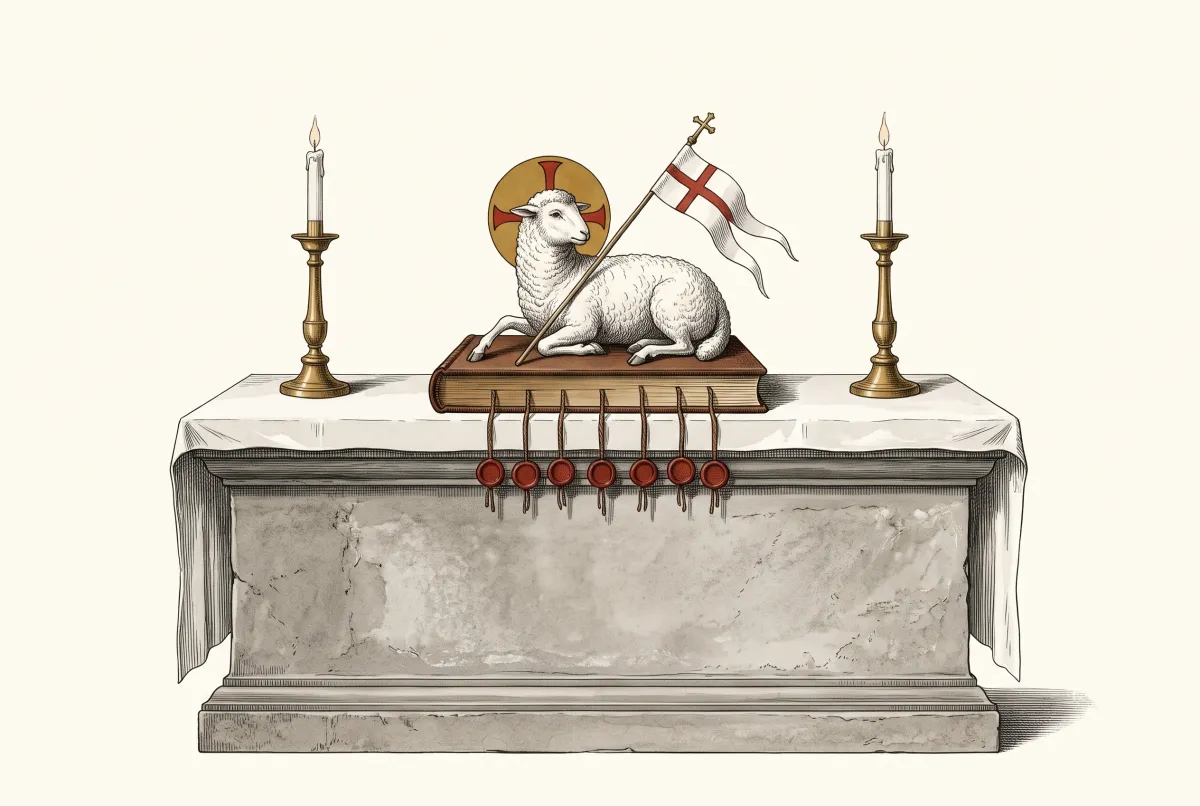
Upon the altar, at every Mass, the sacrifice that Jesus Christ offered once for all upon the Cross is made present. What takes place before you is neither a mere memorial nor a beautiful ceremony: it is Calvary itself, offered to God in an unbloody manner by the hands of the priest. To understand it, one must go back very far, to the first sin, and follow the thread of the history of salvation. This guide leads you there, and then accompanies you step by step, from the sprinkling with holy water at the beginning to the Last Gospel.
Are you preparing for your first Mass and wish to go straight to the steps? The outline of the Mass lists them all; you may return to this introduction later.
What is the Mass?
A broken friendship
God created man to live with Him. But Adam and Eve, in the garden, preferred their own will to His: this is original sin (Gen. 3). The bond was broken. Man, driven from paradise, retains deep within himself the desire for God, yet he can no longer, by his own strength alone, repair the offense committed against an infinite God. From that very moment, however, God promised a Savior, born of the woman, who would crush the serpent’s head (Gen. 3:15).
The sacrifices of the Old Covenant
To acknowledge God as their Lord and to implore His pardon, men offer Him sacrifices: they give Him a precious good, often a life, and destroy it for Him, in order to signify that they belong to Him entirely. Abel offers the firstlings of his flock, and God looks with favor upon his offering (Gen. 4:4). Melchisedech, king and priest, offers bread and wine (Gen. 14:18). Abraham receives the command to sacrifice his son Isaac; he obeys, and at the last moment God stays his hand and Himself provides the victim: a ram caught in the briers (Gen. 22:8-13).
Then comes the Pasch. In Egypt, each family of Israel immolates a lamb without blemish; its blood, sprinkled upon the doorposts with a bunch of hyssop, turns away the destroying angel. They eat the lamb dressed for a journey, ready to set out toward freedom (Exod. 12). God commands them to keep its memorial every year. Later, in the Temple of Jerusalem, a lamb is offered every morning and every evening (Exod. 29:38-42), and the blood of victims flows continually for the sins of the people.
Sacrifices that did not suffice
All these sacrifices were willed by God, yet they were only a figure, a foreshadowing. "It is impossible that with the blood of oxen and goats sin should be taken away" (Heb. 10:4). There was need of a victim worthy of God, and of a priest who was both one of us and without sin.
The true Lamb
This victim is the Son of God made man. When Saint John the Baptist sees Him coming, he points Him out: "Behold the Lamb of God, behold him who taketh away the sin of the world" (John 1:29). Jesus dies upon the Cross on the day of the Preparation of the Pasch (John 19:14; 19:31), at the hour when the lambs were immolated; as with the paschal lamb, not a bone of His is broken (John 19:36; Exod. 12:46). "Christ our Pasch is sacrificed" (1 Cor. 5:7). He is both priest and victim, and He offers Himself "once for all" (Heb. 10:10). This is the last sacrifice, the one that fulfills all others and brings them to an end: what Abel, Isaac, and the paschal lamb prefigured is now accomplished.
The Last Supper: "Do this for a commemoration of me"
On the eve of His Passion, during the paschal meal, Jesus takes bread and says: "This is my body," and then the chalice: "This is my blood of the new testament, which shall be shed for many" (Matt. 26:26-28). He adds: Hoc facite in meam commemorationem, "Do this for a commemoration of me" (Luke 22:19). By these words, teaches the Council of Trent, He establishes His Apostles priests of the New Covenant and commands them, and their successors, to offer this same sacrifice.
The Mass, the same sacrifice
The Mass is therefore not another sacrifice than that of the Cross, nor a repetition meant to complete it. It is the selfsame sacrifice, made present upon the altar: the same Christ offers Himself there, the same victim is present there, but in an unbloody manner, under the appearances of bread and wine.
For the victim is one and the same: the same now offering by the ministry of priests, who then offered Himself on the Cross, the manner alone of offering being different.1
The priest does not act in his own name. He lends Christ his voice and his hands; he acts, as the Church says, in persona Christi, "in the person of Christ." That is why, at the consecration, he does not say "this is the body of Christ," but "this is my body." The prophet Malachias had foretold it: from the rising of the sun even to the going down, in every place, there is sacrificing, and there is offered to the name of God a clean oblation (Mal. 1:11).
Why the sacrifice is offered
The Mass renders to God what we owe Him. Catholic tradition distinguishes four fundamental ends of the sacrifice:
Eating the Lamb
The Israelites did not merely immolate the paschal lamb: they ate it. In the same way, the sacrifice of the Mass is completed by Communion, in which we receive the immolated Lamb Himself. "Except you eat the flesh of the Son of man, and drink his blood, you shall not have life in you" (John 6:54). The Eucharist is thus both a sacrifice, offered to God, and a sacrament, given to the faithful. A sacrament is a sensible and efficacious sign of grace, instituted by Jesus Christ to sanctify us: it effects what it signifies. The Eucharist is the greatest of the sacraments, for it does not merely give grace: it contains Christ Himself, who is its source. The celebrating priest must receive Communion, under both the Body and the Blood of Christ: his Communion completes the sacrifice, and without it the Mass would be incomplete. For the faithful, Communion is not obligatory at every Mass. The Council of Trent desires that they communicate at every Mass at which they assist, but does not make it a condition: one who does not communicate nevertheless takes part in the sacrifice offered for him (Session XXII, Chapter 6). The Church strictly requires Communion only once a year, during the Easter season.
To receive Communion, one must be a Catholic, in the state of grace (free from unconfessed mortal sin), and fasting. One who cannot receive sacramental Communion assists fully at the sacrifice and may make a spiritual communion, desiring with all his heart to receive Christ.
This thread throughout the Mass
You will find this history woven throughout the rite. After the consecration, the priest asks God to accept the offering as He vouchsafed to accept the gifts of His just servant Abel, the sacrifice of Abraham, and that of Melchisedech (the prayer Supra quæ). Before Communion, the Agnus Dei is sung three times: "Lamb of God, who takest away the sins of the world." Then the priest shows the host to the faithful, taking up the words of Saint John the Baptist: Ecce Agnus Dei, ecce qui tollit peccata mundi.
The principal parts of the Mass
The Mass always unfolds in the same order. This guide divides it into six parts:
- Before the Mass: on Sundays, the sprinkling with holy water.
- The Mass of the Catechumens: from the prayers at the foot of the altar to the Credo. Here we pray and listen to the word of God in the Epistle and the Gospel. It bears this name because, in the early Church, those preparing for baptism — the catechumens — were permitted to attend this part and then withdrew.
- The Offertory, the first part of the Mass of the Faithful: the priest offers the bread and wine that will become the Body and Blood of Christ.
- The Canon, the heart of the Mass: the great sacrificial prayer, said in a low voice, in the midst of which the consecration takes place.
- The Communion: from the Pater Noster to the last prayer.
- The Conclusion of the Mass: the dismissal, the final blessing, and the Last Gospel.
The Tridentine rite and the 1962 Missal
The term "Tridentine Mass" refers to the Mass celebrated according to the Roman Missal promulgated by Saint Pius V in 1570, following the Council of Trent (in Latin, Tridentum). The Pope did not invent a new rite: he codified, for almost the entire Latin Church, the ancient usage of Rome, the substance of which — and notably the Canon — goes back at least to Saint Gregory the Great, around the year 600. This missal underwent minor revisions over the centuries; the edition followed today in traditional communities is that of 1962, promulgated under John XXIII. That is the edition followed by this guide.
You will notice three things. The Mass is said in Latin, the language of the Roman Church since the early centuries. The priest faces the altar, turned in the same direction as the faithful, like one leading his people toward God. Finally, a large part of the prayers, including the entire Canon, is said in a low voice: this silence does not exclude the faithful, but invites them to unite themselves interiorly with what is being accomplished.
High Mass and Low Mass
The same Mass may be celebrated in several ways.
- Sung Mass, or High Mass (Missa cantata), is the principal Sunday Mass in most chapels. The priest sings certain prayers, the choir sings the other parts in Gregorian chant, and the altar is often incensed. When the priest is assisted by a deacon and a subdeacon, it is called a Solemn Mass (Missa solemnis).
- Low Mass (Missa lecta) is said without singing. The priest reads all the prayers, and a server answers him in the name of the faithful. This is the usual form on weekdays, and often for the early Mass on Sunday morning.
This guide takes the Sunday High Mass as its point of reference. What differs at Low Mass is indicated, at each relevant step, in a callout box.
Following the Mass with your missal
The Mass consists of two kinds of texts. The Ordinary (Ordo Missæ) does not change from day to day: you will find it here in its entirety, in Latin with the English translation alongside. The Proper (Proprium) changes every day according to the Sunday or feast: the Introit, Collect, Epistle, Gradual, Gospel, Offertory, Secret, Communion, and Postcommunion. This guide explains what these parts are without reproducing them: look them up in your hand missal at the Mass of the day, and place your ribbons there before the celebration begins.
Each step also indicates the posture of the faithful: standing, sitting, or kneeling. These indications follow the most common usage in traditional chapels. Where customs vary, the page notes it ("according to local custom"); when in doubt, follow the example of those around you.
Three kinds of indications are interwoven throughout this guide, and it is worth distinguishing them. The rubrics of the missal govern what the priest does; they say very little about the laity. Customs vary from one chapel to another: postures, responses, chants. Finally, counsels suggest a way of praying at a given moment: they are meant to help, not to bind, and one may pray otherwise without fault. The outline further down on this page leads to every step; on each step page, the "Previous" and "Next" links at the top of the screen take you forward step by step.
It is not necessary to read or follow everything the very first time. It is better to enter little by little into the prayer of the Church: read this guide before Mass, and then, during the celebration, keep your eyes upon the altar.
This guide is still in beta: it is reviewed by its readers. If you find an error, an omission, or a posture that does not match what you observe, please report it on the forum or at forum@scriptorium.page.
Footnotes
-
Una enim eademque est hostia, idem nunc offerens sacerdotum ministerio, qui se ipsum tunc in cruce obtulit, sola offerendi ratione diversa. The same chapter teaches that this sacrifice is truly propitiatory. ↩
The Outline of the Mass
Before the Mass
The Sprinkling with Holy WaterAsperges me1The Mass of the Catechumens
The Prayers at the Foot of the AltarIntroibo ad altare Dei2The IntroitIntroitus3The KyrieKyrie, eleison4The GloriaGloria in excelsis Deo5The CollectOratio6The EpistleEpistola7The Gradual and AlleluiaGraduale8The GospelEvangelium9The Sermon10The CredoCredo in unum Deum11The Mass of the Faithful: the Offertory
The Offertory AntiphonOffertorium12The Offering of the HostSuscipe, sancte Pater13The Offering of the ChaliceOfferimus tibi, Domine14In spiritu humilitatisIn spiritu humilitatis15The Incensing of the OfferingsIncensum istud16The LavaboLavabo inter innocentes17Suscipe, sancta TrinitasSuscipe, sancta Trinitas18Orate, fratresOrate, fratres19The SecretSecreta20The Mass of the Faithful: the Canon
The PrefacePræfatio21The SanctusSanctus22The Beginning of the CanonTe igitur23Hanc igitur and Quam oblationemHanc igitur24The ConsecrationQui pridie25The Offering of the VictimUnde et memores26The Commemoration of the DeadMemento etiam27The Final DoxologyPer ipsum28The Mass of the Faithful: the Communion
The Pater NosterPater noster29The Fraction and ComminglingPax Domini30The Agnus DeiAgnus Dei31The Prayers before CommunionDomine Jesu Christe32The Communion of the PriestDomine, non sum dignus33The Communion of the FaithfulEcce Agnus Dei34The AblutionsQuod ore sumpsimus35The Communion AntiphonCommunio36The PostcommunionPostcommunio37Begin reading: The Sprinkling with Holy Water
This guide is currently being proofread. Spotted an error, an omission, or a posture that differs in your chapel? Write to us at contact@scriptorium.page.